Furry art is a loaded term. To contextualize furry media, to write mythological histories of Californian fandom conferences, psychosexual cartoon analysis, digital freakshow culture, or manifestos on new gay revolutions all orbit the actual use of anthropomorphication. Our current culture is so self consciously postmodern that to explain how images of things have a life of their own is trite. The way in which we interact with the world and each other as humans is deeply burdened with the social. Our beauty standards, aesthetics references, and social standards are deep examples of simulacra; they are copies without originals and everyone participating in them is aware of its artificiality.
It comes as no surprise that many, particularly queer and neurodivergent individuals, find it difficult to confidently place and perform identity in a social context. Many find comfortability in abstracting their identity upon a nonhuman subject, to infinitely manifestable possibilities. While it is quite utopian to imagine furry identity as unburdened by worldly hierarchy, it is a strong part of what is so appealing about furry to so many--to reinvent oneself and to be able to interact with a community of others on an equal plane of self actualization.
Furry as an inherent engagement with fantasy does not constitute the medium as requiring a detachment from reality more than any other artistic medium. Literature has long concerned itself with the anthropomorphication of ideas, with characters and situations that share neither a surface level connection to reality nor layered, humanistic interior worlds, and a lack of lifelike contexts and characters has never obscured a story from revealing human truths. To deal with human subjects is just as strong of a contextualization behind a work as any other. To make a work in the “human” world is to engage with a very particular geographic and temporal understanding of truth. The real human is always present in fantasy, as the human consciousness is the only possible perspective an artist and audience can come from. Even if a work of fantasy requires a transposing of consciousness into an imagined third person perspective, a belief that the world has nothing to do with our own, the work of fantasy is always the human consciousness being projected into fantasy, just as any artistic work is a projection of human consciousness into a defined world.
Furry as a specific engagement with fantasy is an uncertain term, and it must be specified whether one is speaking about furry as an ideology or furry as a culture. The concept, the ideological core of furry, is the projection of human consciousness onto invented subjects inherent in any artistic expression, or anthropomorphication. Defining furry as a culture is slippery, as it can be just as abstract, but requires some kind of boundaries to pinpoint the internet accelerated cartoon aestheticism referenced by most artists today blending furry and fine arts contexts.
Many furries take pride in the undefinability of furry, the lack of a central media, interest, or hierarchy that sets a standard for what is required in order to be furry. In defining furry, any boundary of subject and predicate is infinite beyond the base idea of anthropomorphism. Furry culture may exist in many different forms influenced by the media landscape of a particular continent or generation (90s furry is visibly distinct to 2000s furry, Western furry is distinct to Eastern furry, etc.), and to define furry beyond its ideological base is like catching water in a sieve. The primarily online and Western image of furry culture is merely a kaleidoscope people push their own identity through. It represents a community of people anthropomorphizing themselves not just through animals, but through what furry animals should look like.
The history of those who make a freakshow of the furry community, the history of masculine internet culture denigrating the most gay and neurodivergent looking anthropomorphic enjoyers, helped create the cringe culture spectacle still present in popular perception of the community, albeit fadingly. Nevertheless, these interactions with the fandom remain influential in the popular perception of furry, why some art looks more furry to the average person than others. It is a culture exploded across digital and physical spaces by the infinite contexts of its participants and bullies, and it is this distinctly contemporary, digital, and Western conception of furry that I will be referencing when I speak of furry culture.
In the work of many recent artists blending the context of furry culture and contemporary art, these qualities come to the surface. One of the more cohesive places to find furry artists who want to engage with the fine arts context is through the exhibition Room Party: Furry Art at the Beginning of the World, at Bunker Projects in 2025. I hold great admiration for these artists and curators. These are artists who despite any and all forthcoming criticism or analysis make work that is blindingly beautiful in its belief of community and what this niche, fetishistic subculture can unlock in a person alone. It is in this overlap of anthropomorphication and the larger narrative of contemporary art that I speak of Furry Art, with both capital letters, and will attempt to carve out the history and implications of.
Mike Kelley’s Arenas is likely one of the most seminal pieces of Furry Art. It is a series of found object sculptures, blankets and stuffed animals in still compositions. Arenas is a visibly modernist exercise in an era of work utilizing stuffed animals to connect gift giving with guilt and debt, exemplified by the other more popular work More Love Hours Than Can Ever Be Repaid. Despite Kelley’s intentions to deconstruct these anthropomorphic plushes back into objects, audiences overwhelmingly projected humanity into the toys to the degree that many presumed the artist to be a victim of child abuse, and the works as a processing of trauma.
What was meant to de-anthropormorphacize instead exaggerated projected human emotions, and Mike Kelley would spend much of the rest of his career responding to why audiences apparently wanted to see biographical trauma within art. What Arenas exemplified is the anthropomorphication inherent in art contexts. To put an object in a gallery is to anthropomorphize that object, to give it an invisible mouth, to make an object perform, to make the object some thing that is speaking to you as a result of the artist’s animation.
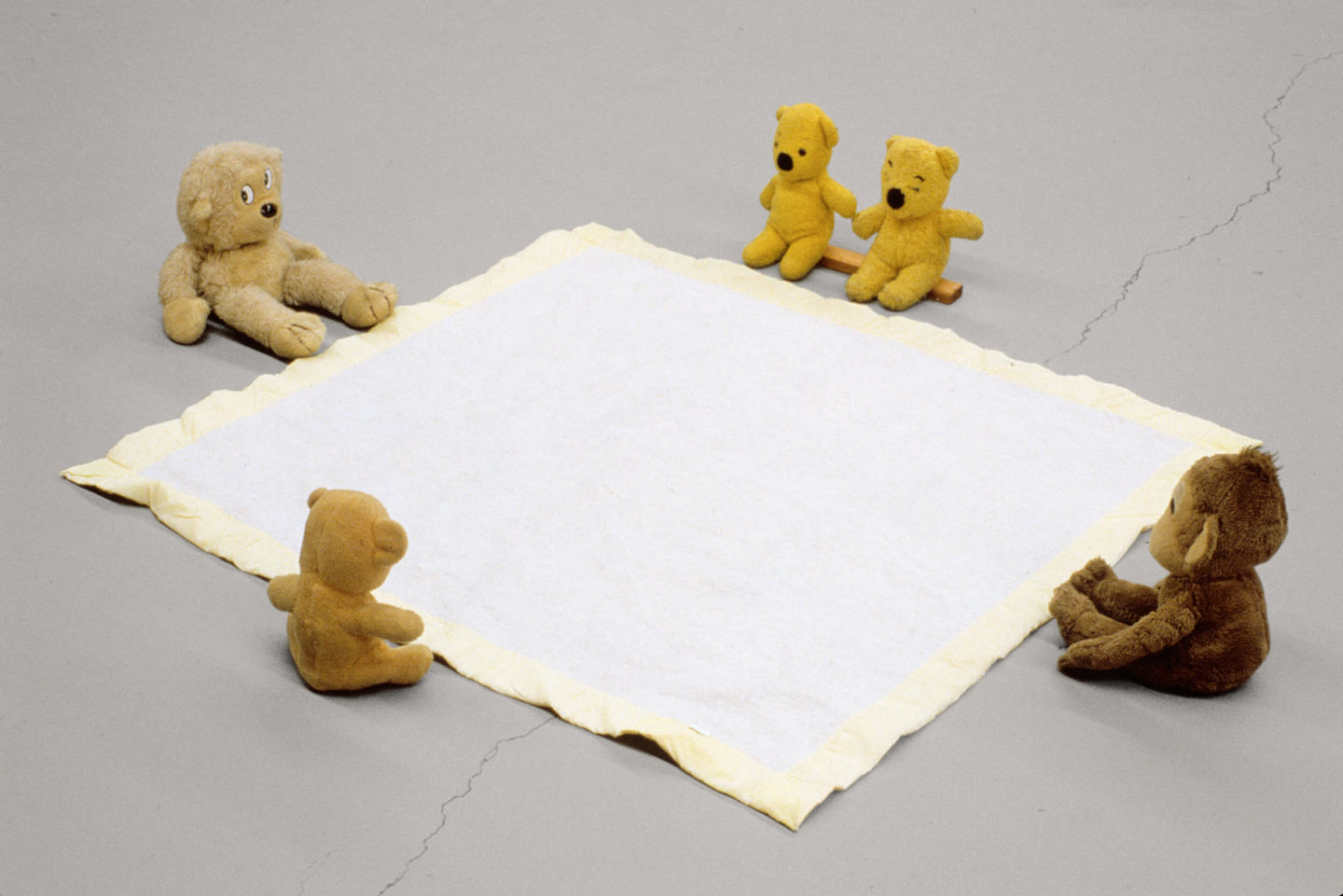
Mike Kelley, Arena #7 (Bears), 1990
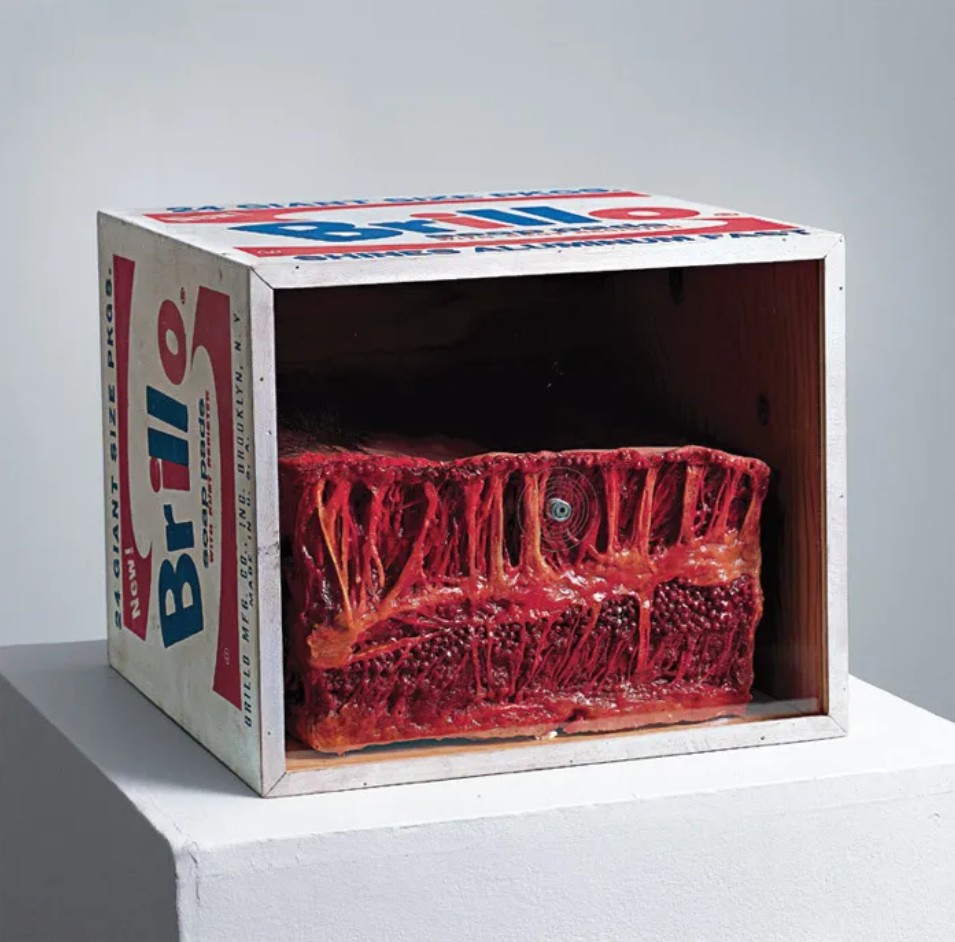
This anthropomorphic context of art can be seen in Duchamp’s Fountain or the concept of the art object, the readymade, anti-object, etc. Many postmodern artists in the late 20th century like Paul Thek quite literally humanized objects through placing slabs of flesh inside boxes reminiscent of minimal and pop art. Furry art as a mode of expression holds just as much versatility as sculpture. A fursona or anthropomorphic character does not have to reflect the artist’s personal identity more than any work of art is implicated in the biographical. Industrial products and fictional characters are equally useful vessels to the viewer, as some thing to be projected into.
In numerous Maya Ben David videos, there are destructively psychosexual relationships between Air Canada Gal and Spiderman, pregnant Ferris Wheels, and Popcorn Ceiling Maidens lamenting to the viewer about their obsolescence. These videos are uploaded online, embodying a completely online DIY aesthetic. These YouTube videos are steeped in self aware artifice, making the effort (and occasionally lack thereof) of costuming and set design just as much of the text of the work as its subtext. Wearing costumes that seem to exaggerate the human performer rather than hide, David is addressing the viewer as the artist performing as the artist performing as the object. It is through this intentional artifice that one may believe they see the real Maya Ben David clearer than anywhere else. All other videos on the platform feel fake in comparison, while the abstracted self you see wearing the Air Canada Gal uniform is so highlighted that she is much more real than anyone else attempting to mask their performance. (All these qualities of performance and self awareness ring true for Ryan Trecartin, though his work more often embodies human caricatures--debatably anthropomorphic.) This meta-anthropomorphication of the work itself is reminiscent of conceptual artists like John Baldessari, an expert in the self-aware, self flagellating artwork, seen in bodies of work like Commissioned Paintings. Not executed by John Baldessari, they are paintings pretending to be paintings by a painter pretending to paint--within this artifice, an honest painting.

John Baldessari, Commissioned Painting: A Painting by Pat Nelson, 1969
What stands in Furry Art is its engagement not with anthropomorphication, but with furry culture and its approximations. Through the late 2000s, furry art has grown into an identifiable aesthetic separate from the most popular examples of anthropomorphic animals, often featuring hyperreal fur and facial features bordering on self caricature. Instead of participating in anthropomorphication within the work of art (the art is the making of a fursona), many figurative Furry Artists allude to the products of furry artists as a mythology, canonizing specific stylistic choices as the objective image of Furry (the art uses an existing fursona).
Tommy Bruce and Mark Zubrovich are artists who deal with the furry image, as they use their personal fursonas as the subject of their work. Zubrovich paints himself as the blue dog Bruce in scenes of self mutilation, sex, power, despair. Zubrovich is Bruce through and through, and the consistently cartooned stylization (informed by the same genre of cartoons behind Bruce’s design) of human Zubovich in sparse depictions makes the viewer see Bruce as the real depiction of the artist, and his human form as alien. In scenes equally slapstick and melancholically homoerotic, Bruce is both fire hydrant and pissing dog, both fursuit and wearer in one character. For Mark Zubrovich, there is no irony or detachment from Bruce. There are no depictions of Mark Zubrovich that are not also Bruce. In line with Albrecht Dürer, it is the dressing and contextualization of the depicted self that current and future historians will analyze as if these paintings were direct reflections of their interiors--all readings of Bruce’s actions and emotions have biographical implications on the artist through this lens.
In this work, furry is not an action or context, but the artist’s anthropomorphic world is the base of reality. When Bruce is depicted as a fire hydrant, one immediately sees the connotation of pisser and pissee, because in Bruce’s world there is no other connotation for what a fire hydrant could be. It is in this level of belief in the anthropomorphic world, this kind of kayfabe, that the most popular examples of furry culture exist--there is no human pretense at a furry convention if the participants already understand that they are seeing a more true self within the fursuiter. There is no boundary or need to step in or out of the furry world, as Bruce is Mark in many literal senses--the most significant point of projection is Bruce's strong sense of smell and its poignancy in his personal identity and sexual desires. Mark Zubrovich’s sense of smell was permanently damaged in 2020 as a result of COVID-19, and Bruce is an explicit representation of his healing process.
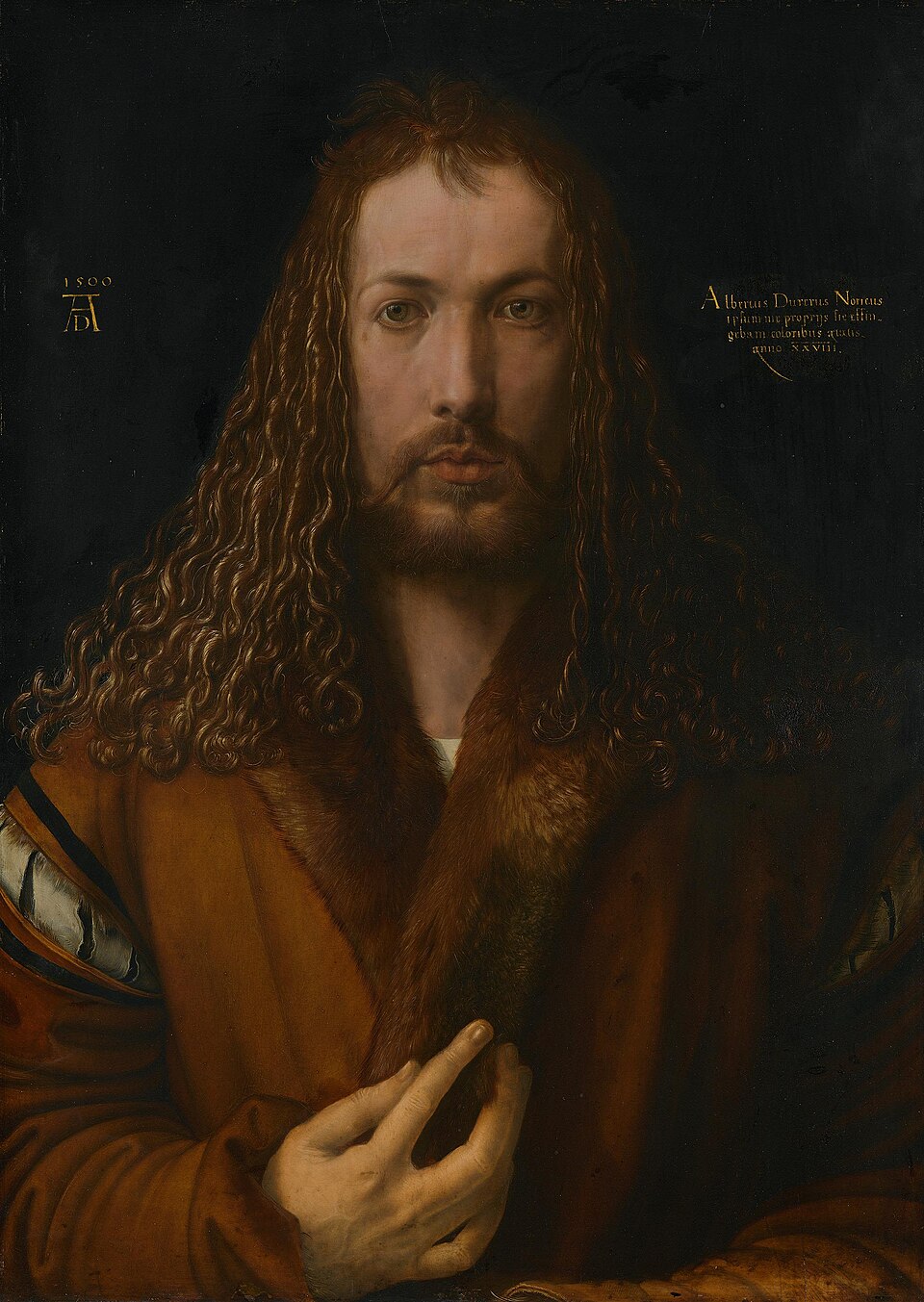

Albrecht Dürer, Self-Portrait, 1500 and Mark Zubrovich, SNIFF! SNIFF! YOU WERE HERE!, 2023
Furry as an ideology of anthropomorphication has long been present in the art object, and furry culture as the subject of visual art holds existential and critical potential. Two recent exhibitions taking place during the past Anthrocon in Pittsburgh stand as an inflection point in the potential of furry identity in an artistic context, as ROOM PARTY one year earlier was emblematic of.
Presented during Anthrocon, Furpile by Patrick Totally opened throughout Pittsburgh in bars, playgrounds, libraries, and dilapidated carpet stores. The exhibition was also brought to the lobby of Anthrocon, and even to the center of Bunker Projects, surrounded by I LOVE FURRY. The exhibition(s) consisted of various figurative and abstract plush sculptures made by various artists dumped in the center of each space to be held and played with by attendees. As an exhibition of many small sculptures, Furpile features work that even in its most abstract products constitutes the act of anthropomorphication, whether that be of animals, humanoids, concepts, or thoughts intentional and incidental. The intentionally haphazard naivety of the exhibition’s presentation, from the dumping of plushies to the carpet store basement to the net art referential flyers, is a rejection of the aesthetic art context most object artists work within (white walls, intellectual briefings on context and content). Through these decisions, Furpile is more of an art performance than an exhibition of many sculptures--the cumulative ritual donation of said plushies to a local Goodwill being the grand finale of a two week parade across Pittsburgh.

Patrick Totally, Mr. Painting, 2025
What is uniquely furry (in ideology and culture) about Furpile is the potential for the plushies to have further lives as new objects to be projected onto by their future owners. The sculptures do not just have infinite potential lives as interpreted art objects, but as plushies, objects with a different intimacy in people’s lives that are examples of the potential behind anthropomorphic actualization for children and adults alike. Furpile is an exhibition of furry art and a dispersion of products that convert rational children and adults alike into anthropomorphic believers, it is furry as subject and action, a Happening just as much as an exhibition.
In all of Patrick’s work, there is a desire to reject the linear conventions of art and audience, an engagement with furry as an ideology and art as a deeply burdened context (see Dungeon, a solo painting show in an abandoned, half demolished suburban house). This is emblematic in his series of abstract paintings, at times borrowing from modernist abstraction to the edge of formalist painting, it is in the scarce use of figurative and culturally furry imagery that makes one question the furry implications of even the most abstract images, these formalist images tainted by an inference of anthropomorphic perverseness. As Patrick’s paintings slide from total abstraction (Reactor) to an anthropomorphic deer (More Than a Woman) to a messy fox dripping onto a separate gray canvas (Mr. Painting), all of his paintings begin to look less like paintings and more like anthropomorphic canvases, responses to painting within an ideologically furry context. In Patrick’s work there is an acceptance that there is no escaping the burdens of an art context in all its formalist expectations, the kind of nuance around aesthetic subversion’s limits that Mike Kelley would retroactively decide was his formative trauma projected in Arenas. There is also a successful exorcism of the painting quality in this objectification/anthropomorphism of the canvas, in the same way Paul Thek brought the mythologized minimalist sculpture into an object through his Technological Reliliquaries, wax sculptures of meat and viscera inside thick glass boxes, a literal and visceral humanization of the most divorced and sterile qualities of art framing.


Tommy Bruce, I LOVE FURRY, and plush by Halo Lahnert for Furpile
I LOVE FURRY curated by Tommy Bruce took place simultaneously at Bunker Projects, the previous site of ROOM PARTY. The exhibition served as a shrine to a community of local and international furries who submitted photos, illustrations, and texts documenting furry paraphernalia, art, memories, and relationships within the community to open forums posted by Tommy Bruce online.
The exhibition references Learning to Love You More by Miranda July and Harrell Fletcher, an online project that crowdsourced responses to specific assignments of more abstract quality. These assignments were less biographical or interpretive and instead intentionally limiting: Take a family portrait of two families, or Make an encouraging banner. Despite a small exhibition history, these assignments were intended to be posted online, and in contrast to I LOVE FURRY, encouraged a sidestepping of biography, the inherent desire to present oneself in a controlled and considered manner online. Assignments that did involve presenting aspects of oneself would then be abstracted in the hands of others, e.g. Write your life story in less than a day preceding Illustrate a scene or make an object from Paul Arensmeyer's life story. These assignments obfuscated or outright rejected open-ended interpretations or opportunities to curate one’s image outside of what was absolutely necessary, in contrast to I LOVE FURRY, a collection of people’s consciously considered presentations of themselves and their experiences.
What July and Fletcher understand is that in any context online, even if we have the power to curate our own identity, the expectation to use these trained muscles of self consciousness is a limiting burden. By sidestepping our most obvious performative instincts, the qualities of the submissions and their documentation feel blindingly real, like there are true pieces of human experience left behind--a quality present in furry art, but less in the presentation of furry art as Furry Art. (Furry as anthropomorphication holds more abstract potential than furry as visual culture.) The strength and beauty of I LOVE FURRY, other than its value as a physical meeting space for furries, is more poignantly present in the existing social media and internationally dispersed grassroots communities from which the content of the submissions arise. The existence of community is a beautiful thing, and to document said community within an art context often feels like a dislocation away from the structural qualities that make that community special. What I LOVE FURRY reminds me is that maybe new possibilities for community don’t have to engage with such linear systems--to define the community within a very specific localized, temporal, aestheticized context is to inherently close the community within a definition. I LOVE FURRY is, according to attendees, a truly beautiful tribute to an image of a community of a very particular place, time, and context, frozen for the galley.
The strength and beauty of I LOVE FURRY, other than its value as a physical meeting space for furries, is more poignantly present in the existing social media and internationally dispersed grassroots communities from which the content of the submissions arise. The existence of community is a beautiful thing, and to document said community within an art context often feels like a dislocation away from the structural qualities that make that community special. What I LOVE FURRY reminds me is that maybe new possibilities for community don’t have to engage with such linear systems--to define the community within a very specific localized, temporal, aestheticized context is to inherently close the community within a definition. I LOVE FURRY is, according to attendees, a truly beautiful tribute to an image of a community of a very particular place, time, and context, frozen for the gallery--a taxidermy.
It is because of this nuance that I have put great effort into elaborating the difference between furry ideology and furry culture, and the great specificities that define the kind of furry culture these artists are engaging with. The majority of furries in online spaces will agree that it does not require a fursuit or to attend (American) furry conventions in order to be a furry, but this contends with the alleged arbiters of said furry community. A whole wall of I LOVE FURRY was dedicated to custom convention badges. In speaking to artists and attendees surrounding furry art exhibitions, criticism hits a wall in the fact that because I was not there to see it myself, because I have never attended a furry convention, I do not understand these more fundamentally furry spaces.
I LOVE FURRY raises broader suspicions about the radical potential of furry as an artistic and cultural force. I have put much effort into contextualizing the specific subjects and media that these artists work with under the presumption that everyone is aware of the burdened context of art, but the utopian imagination of furry without equal engagement of the broader visual culture it is indebted to can feel misguided and exclusionary. Many furry artists today appear to believe their aesthetic fell from the heavens, as if a small range of Western cartoon aesthetics is the destined future for self actualization. The broad lengths to which furry artists speak of their art as about self actualization and community and not about American pop culture, this narrow imagination, runs the risk of intellectually stunting the work and any discussion about furry identity. Furry is a transcendent ideology, though much work today instead engages with a specific Western pop culture phenomena, and it is difficult to write about the critical potential of said art while ignoring that said utopian cultural vessels are aesthetic remixes of Disney properties. These are biases that influence any depiction in art, especially the bias of the art context itself, but furry art cannot build an alleged radical future of identity without confronting its basis, or American furry artists will keep making American furry art with American borders (so to be said in a Western, male, white, etc. context).
to be continued, probably.